
ForceBeyond Logo
Custom precision metal casting components manufactured via investment, sand, and die casting processes

Custom Metal Casting Services: Precision Near-Net-Shape Solutions

Integrated Casting Capabilities for Complex OEM Components

ForceBeyond provides high-integrity custom metal casting services through an integrated network of qualified foundry and machining facilities. Utilizing advanced foundry technologies—including Vacuum Investment Casting, Automated Green Sand Molding, Resin No-Bake Casting, and High-Pressure Die Casting—we transform complex engineering prints into dense, high-strength, near-net-shape components.

Through qualified manufacturing programs and documented quality controls, our global supply network supports mission-critical cast parts for the aerospace, medical, automotive, energy, and heavy equipment sectors. By integrating primary casting with secondary Hot Isostatic Pressing (HIP), thermal heat treatment, and precision machining, ForceBeyond helps minimize internal porosity, maintain tight dimensional tolerances, and provide complete material traceability.

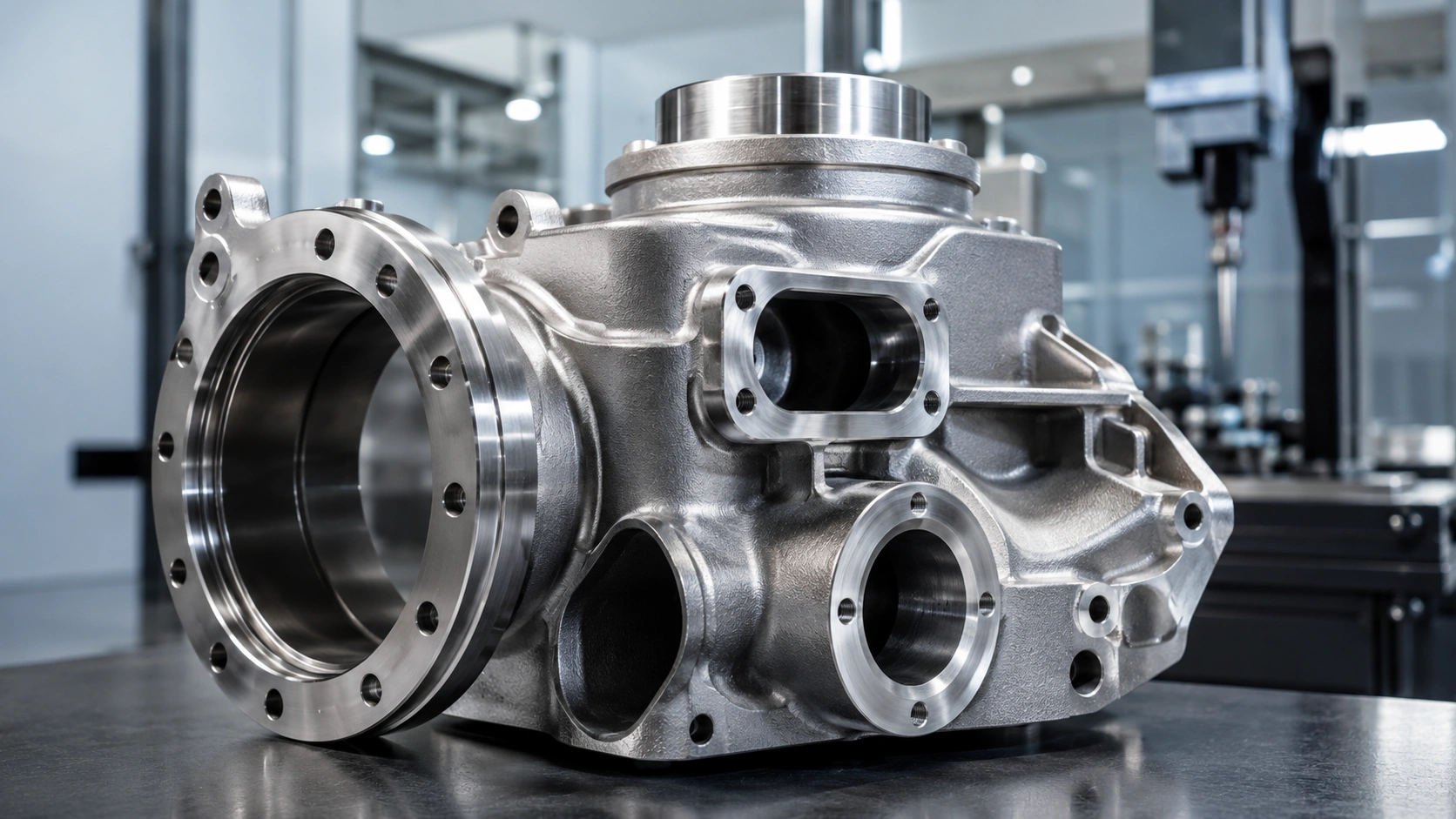
Custom investment-cast metal component for aerospace and energy applications

Core Casting Processes & Technical Capabilities

ForceBeyond matches your part geometry, alloy composition, and production volume to the optimal casting process to minimize unit cost and eliminate material waste:

Casting Process Ideal Volume & Part Size Surface Finish & Tolerances Key Process Advantages & Primary Alloys
Investment Casting (Lost-Wax) Low to High Volume
(Micro to 100 lbs)
125 RMS Surface Finish
Linear Tolerance: ±0.005 in/in
Exceptional geometric freedom, thin-wall capabilities (≤1.5mm), and minimal secondary machining. Ideal for Superalloys, Stainless Steel, and Titanium.
Automated Sand Casting Mid to High Volume
(1 lb to Multi-Ton)
250–500 RMS Surface Finish
Linear Tolerance: ±0.030 in/in
High-speed, cost-effective production for large structural components using Green Sand or Chemically Bonded Resin. Ideal for Ductile Iron and Carbon Steel.
High-Pressure Die Casting High Volume (>5,000 pcs)
(Small to 50 lbs)
63–125 RMS Surface Finish
Linear Tolerance: ±0.002 in/in
Rapid cycle times, thin walls, and high dimensional repeatability for lightweight Aluminum and Zinc alloys.

How to Choose the Right Metal Casting Process

The best casting method depends on annual production volume, part weight, wall thickness, alloy, tooling budget, surface finish, and dimensional requirements. ForceBeyond reviews your drawings and operating conditions to recommend the most cost-effective process for both prototype and production programs.

  • Choose investment casting for complex geometry, thin walls, premium alloys, and reduced machining allowance.
  • Choose sand casting for larger components, lower tooling investment, broad alloy flexibility, and low-to-high production volumes.
  • Choose high-pressure die casting for high-volume aluminum, magnesium, or zinc components requiring thin walls and repeatable dimensions.

Complete Alloy Casting Capabilities

ForceBeyond pours a broad spectrum of ferrous, non-ferrous, and high-temperature superalloys, engineered to withstand severe mechanical wear, thermal fatigue, and corrosive environments:

Specialized Casting Solutions by Material and Process

ForceBeyond organizes its casting capabilities by process and material so engineers and sourcing teams can move directly from a general requirement to the most relevant specialized service:

For broader grade selection and engineering references, visit our Materials & Technical Specifications hub.

The Tier-1.5 OEM Advantage: Cast-to-Assembly Integration

In traditional supply chains, managing separate vendors for raw castings, heat treating, CNC machining, and surface plating introduces severe lead-time delays and vendor disputes over out-of-spec parts.

ForceBeyond applies a Tier-1.5 manufacturing model to coordinate casting, secondary operations, inspection, and logistics through a managed global supply network:

[ Near-Net Casting ] → [ HIP / Heat Treatment ] → [ 5-Axis CNC Machining ] → [ Surface Coating ] → [ Assembly & Kitting ]

Integrated Post-Casting Secondary Operations

  • Hot Isostatic Pressing (HIP): Subjects castings to simultaneous high temperatures and 15,000+ psi Argon gas pressure to physically collapse internal shrinkage voids and achieve near-full theoretical density.
  • Thermal Processing & Heat Treatment: Solution annealing, T6 artificial aging, quenching, tempering, and age hardening (H900/H1150) to optimize mechanical strength.
  • Precision CNC Machining: 5-axis milling, live-tool turning, and Swiss machining support to achieve tight tolerances on critical mounting faces, sealing surfaces, and threads, based on part geometry and process capability.
  • Surface Finishing & Coating: Passivation, electropolishing, Type III hardcoat anodizing, E-coating, and powder coating.
  • Assembly & Kitting Services: Delivering complete, pressure-tested, and torque-verified sub-assemblies directly to your assembly line under a single SKU.

Quality Assurance, Metrology & Non-Destructive Testing

To support quality requirements for safety-critical and performance-sensitive components, ForceBeyond coordinates quality assurance, metrology, and testing and inspection protocols throughout casting and post-processing:

  • Radiographic Testing (X-Ray): Internal inspection for shrinkage, inclusions, and discontinuities when required by the drawing or quality plan.
  • Fluorescent Penetrant Inspection (FPI - ASTM E1417): Exposes microscopic surface-breaking cracks and porosity on sealing faces.
  • Material Traceability: Material test reports and heat-lot traceability can be provided according to project, industry, and customer requirements.
  • 3D CMM & Laser Scanning: Full GD&T inspection maps and First Article Inspection (FAI) reports per AS9102 standards.

Metal Casting Solutions by Industry

ForceBeyond supports custom cast components across the industries represented in our site architecture, with process, alloy, inspection, and secondary-operation requirements tailored to each application:

  • Energy & Power Generation: Turbine, pump, valve, combustion, and power-system components, including programs for data center power and nuclear and SMR systems.
  • Space & Defence: Lightweight structural hardware, high-temperature castings, brackets, housings, and complex near-net-shape components.
  • Oil & Gas: Corrosion-resistant valve, pump, flow-control, and pressure-containing components for demanding service environments.
  • Mining & Heavy Equipment: Wear-resistant castings, housings, liners, teeth, and structural components for severe-duty equipment.
  • Automotive: Aluminum, zinc, iron, and steel cast components for lightweight structures, driveline systems, housings, and production assemblies.
  • HVAC, Fluid & Flow Control: Pump bodies, impellers, valve bodies, manifolds, and fluid-handling components.
  • Medical & Healthcare: Precision stainless-steel and specialty-alloy components requiring controlled surfaces, traceability, and dimensional inspection.
  • Agricultural Equipment: Durable iron, steel, and aluminum castings for machinery, power transmission, and field equipment.

Frequently Asked Questions: Metal Casting

What is the main benefit of Investment Casting over Sand Casting?

Investment casting (lost-wax) provides vastly superior dimensional accuracy (±0.005 in/in) and a smoother surface finish (125 RMS), making it ideal for intricate geometries, thin walls, and hard-to-machine superalloys where minimizing secondary machining is critical. Sand casting is better suited for larger, heavier parts where lower tooling costs and high volume outweigh tight as-cast tolerances.

How does Hot Isostatic Pressing (HIP) improve cast component quality?

During solidification, microscopic shrinkage pores can form inside thicker sections of a casting. Hot Isostatic Pressing subjects the component to elevated temperature and multidirectional argon gas pressure, helping close internal pores through plastic deformation and diffusion bonding. When properly specified, HIP can improve density, fatigue performance, ductility, and overall reliability, particularly in critical investment-cast and superalloy components.

Can ForceBeyond machine castings in-house?

Yes. Under our Tier-1.5 Model, we design the initial casting with the exact optimal material allowance needed for secondary CNC machining. We then transfer the raw casting directly into our 5-axis CNC machining centers to finish critical sealing faces, bearing journals, and threaded holes—helping ensure dimensional conformity while reducing vendor hand-off risk.

Need High-Integrity Custom Metal Castings?

Contact our engineering team today to analyze your drawings, select the optimal casting process, and optimize design for manufacturability.

Sources

Related Casting, Machining, Materials and Secondary-Operation Resources