
ForceBeyond Logo
Forged Inconel 718 rings and high-performance industrial components

Die Casting: High-Volume Precision Manufacturing

Die Casting: High-Volume Precision Manufacturing

ForceBeyond provides superior-quality custom die casting parts and components for a wide range of global industries, including automotive, aerospace & defense, energy, medical devices, and oil & gas. Utilizing advanced die casting presses ranging from 180 to 2,000 metric tons, we have the scalable capacity to produce non-ferrous metal parts weighing from a few grams up to more than 100 pounds.

We specialize in high-volume precision casting across multiple materials, including aluminum die casting, zinc die casting (ZAMAK), A356-T6 structural alloys, and magnesium die casting. Our end-to-end manufacturing network combines engineering expertise with high-speed production, delivering monolithic, high-strength parts that are fully machined, coated, and ready for final assembly.

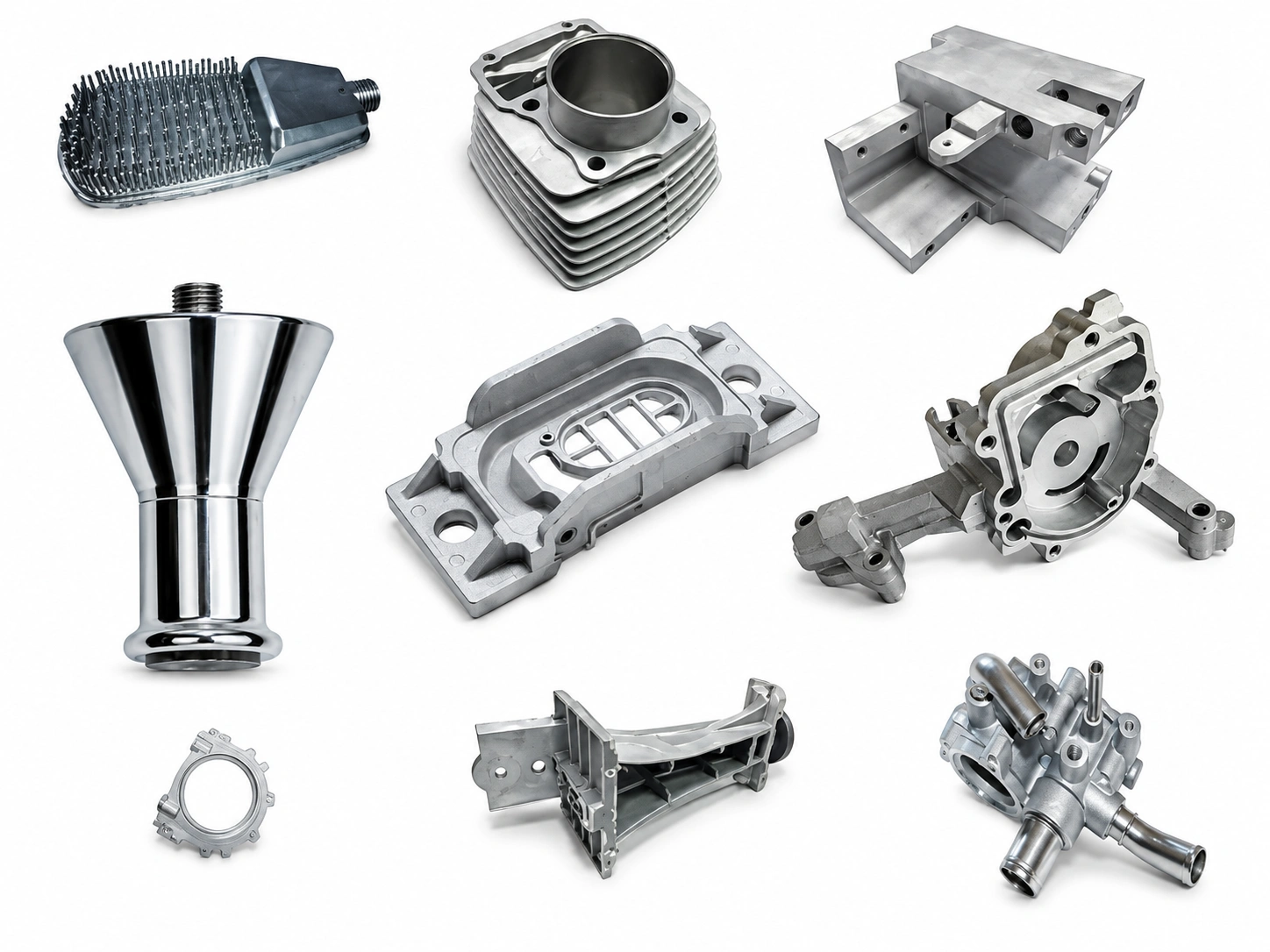
Custom aluminum die-cast parts, including housings, brackets, engine components, heat sinks, and precision industrial castings on a white background.

Technical Specifications: Die Casting Alloys

ForceBeyond ensures all die-cast components meet rigorous dimensional and material standards. We offer a diverse portfolio of aluminum and zinc (ZAMAK) alloys to match the precise mechanical, thermal, and finishing requirements of your application.

Material Grade Tensile Strength (MPa) Thermal Cond. (W/mK) Key Features & Optimal Applications
Aluminum A380 325 96 Best balance of mechanical and thermal properties. High resistance to hot cracking. Ideal for engine brackets and gearboxes.
Aluminum A360 317 113 Excellent pressure tightness and fluidity. High strength in elevated temperatures.
Aluminum B390 317 134 Exceptional hardness and wear resistance. Ideal for combustion engine pistons and compressor bodies.
ZAMAK 2 359 105 Excellent damping capacity and vibration attenuation. High strength and hardness after long-term aging.
ZAMAK 3 283 113 Great balance of physical/mechanical properties. Excellent castability and dimensional stability. Superior plating characteristics.
ZAMAK 5 328 109 Higher copper content for increased strength. More readily plated, finished, and machined than Zamak 3.
ZA 8 374 115 Excellent creep properties, strength, and hardness. Ideal for decorative applications requiring premium finishing.

(Note: We also cast Aluminum 413, 383, A413, A356-T6, and various Magnesium alloys based on project requirements).

Why Partner with ForceBeyond for Die Casting?

A reliable supply of precision non-ferrous castings requires a manufacturing partner with advanced technological capacity and rigorous quality oversight.

  • Extreme Production Speed: The complete cycle of modern die casting is the fastest process available for producing precision non-ferrous metal parts, easily outperforming sand casting or permanent mold casting for high-volume runs.
  • Ultra-Thin Wall Capabilities: Our advanced process control allows for exceptionally thin wall thicknesses (down to 0.040 inches for small castings), significantly reducing part weight while maintaining structural integrity.
  • Near-Net-Shape Accuracy: Our high-pressure injection process achieves remarkably tight tolerances and smoother as-cast surfaces, minimizing the need for extensive precision machining.
  • Monolithic Design Efficiency: Combine multiple components into a single, cohesive part. This dramatically lowers assembly costs and creates an efficient, economical alternative to multi-part stamping or welding.

The Die Casting Process: From Tooling to Ejection

Die casting is characterized by forcing molten non-ferrous metal into a highly precise mold cavity under immense pressure. The process relies on custom-engineered, hardened tool steel dies. These dies are machined in at least two sections (a stationary fixed half and a movable syringe half) to allow for the seamless ejection of complex geometries.

Depending on the alloy being cast, ForceBeyond utilizes advanced hot-chamber (for zinc alloys and low-melting-point metals) or cold-chamber (for aluminum alloys and high-melting-point metals) machines. Once the molten metal is injected, it rapidly solidifies, capturing intricate details, movable slides, and internal coring before the die opens and the part is safely ejected.

Tier-1.5 Integration: Precision Cast-to-Machine & Finishing Solutions

ForceBeyond provides a seamless transition from raw casting to a finished, assembly-ready component. By integrating our high-volume die casting foundries with advanced secondary processing, we eliminate the dimensional “hand-off” risks typically associated with using multiple vendors.

Our In-House Secondary Operations Include:

  • Precision CNC Machining: High-tolerance multi-axis CNC machining (including 5-axis milling, turning, drilling, and tapping) to achieve final print dimensions.
  • Protective & Aesthetic Coatings: Comprehensive surface finishing solutions including E-coating, anodizing, powder coating, painting, and high-quality chrome plating (ideal for ZAMAK alloys).
  • Surface Preparation & Quality Control: Sanding, shot blasting, and bright finishing supported by full CMM dimensional inspection for superior corrosion resistance and cosmetic quality.

Certified Die Casting Applications

Our specialized foundry network supports the world's most demanding sectors with lightweight, corrosion-resistant, and highly complex components:

  • Automotive & Transportation: Engine brackets, transmission housings, heat sinks, and structural vehicle components.
  • HVAC & Flow Control: Hydraulic cylinders, valve bodies, compressor housings, and complex plumbing fixtures.
  • Energy & Oil & Gas: Power infrastructure hardware, explosion-proof housings, petrochemical valves, and mining equipment components.
  • Space & Defense & Medical: Intricate, weight-critical parts requiring exceptional dimensional stability and vibration damping.

Frequently Asked Questions: Die Casting

What is the difference between Hot-Chamber and Cold-Chamber die casting?

Hot-chamber machines contain the metal melting pot within the machine itself and are used for alloys with lower melting points, like Zinc (ZAMAK). Cold-chamber machines require the molten metal to be ladled into the machine from a separate furnace and are used for higher-melting-point alloys like Aluminum, preventing damage to the machine's pumping system.

Why choose die casting over sand casting?

Die casting is significantly faster, produces smoother surface finishes, allows for much thinner walls, and holds tighter dimensional tolerances than sand casting. While tooling costs are higher, the rapid cycle times make die casting far more economical for mid-to-high-volume production.

Which die casting alloy is best for plating and decorative finishes?

Zinc alloys, particularly ZAMAK 3 and ZA 8, offer excellent finishing characteristics. They are highly receptive to plating, painting, and chromate treatments, making them ideal for visible or decorative components.

Request Quote For Die Casting

Sources

Our Internal Resources for Die Casting, Investment casting, Forging and Sand Casting