ForceBeyond Logo
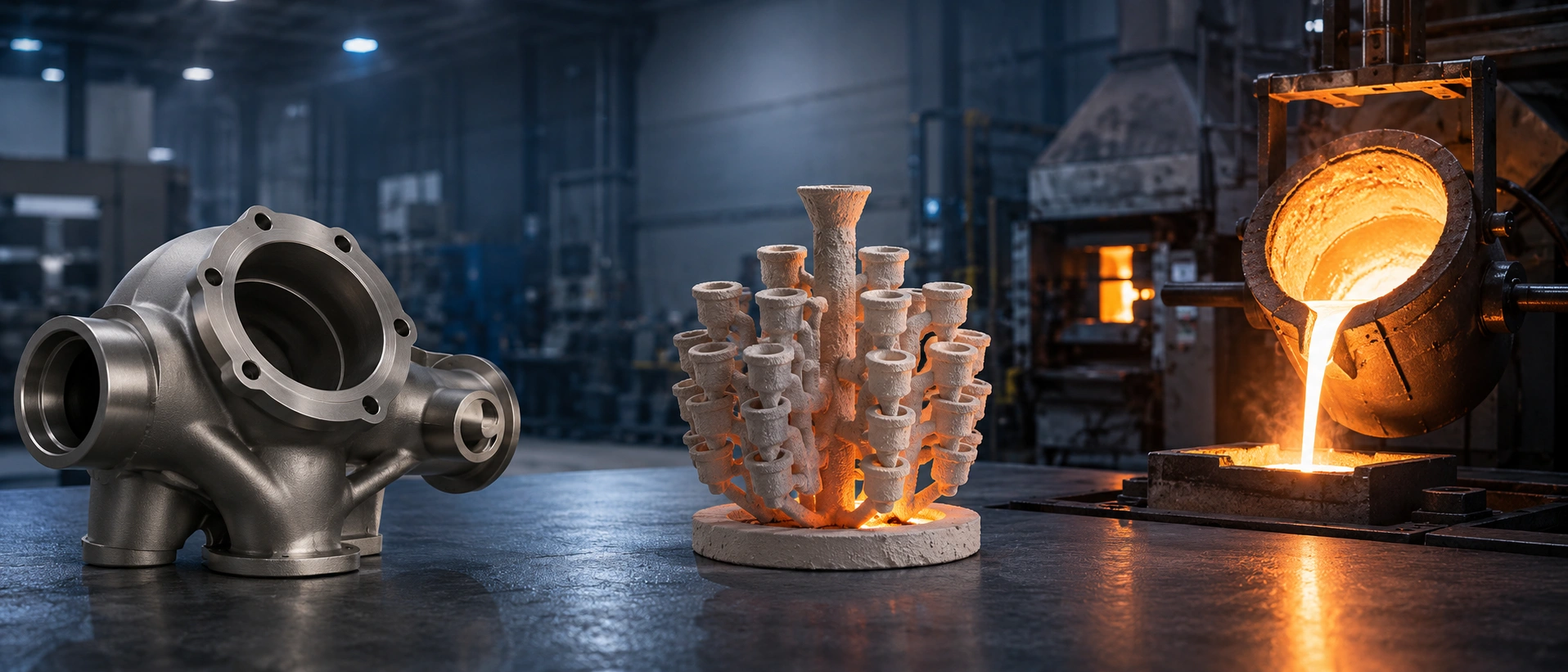
Precision investment cast component tree and ceramic shell preparation in ForceBeyond foundry

Investment Casting (Lost-Wax Process): High-Precision, Near-Net-Shape Manufacturing

Precision Investment Casting Services: High-Accuracy Lost-Wax Manufacturing

ForceBeyond is a premier global investment casting supplier specializing in high-precision, near-net-shape components. Widely recognized as the lost-wax process, investment casting is the preferred manufacturing method for producing complex metal geometries with exceptional surface finishes and tight dimensional tolerances.

Operating under ISO 9001:2015 and AS9100 quality standards, our global foundry network delivers mission-critical custom investment castings to the aerospace, medical, energy, defense, and fluid power industries. From standard carbon steel investment castings to high-spec vacuum-cast Inconel 718 investment cast components, ForceBeyond provides scalable capacity for parts ranging from fractions of an ounce up to 200+ pounds.

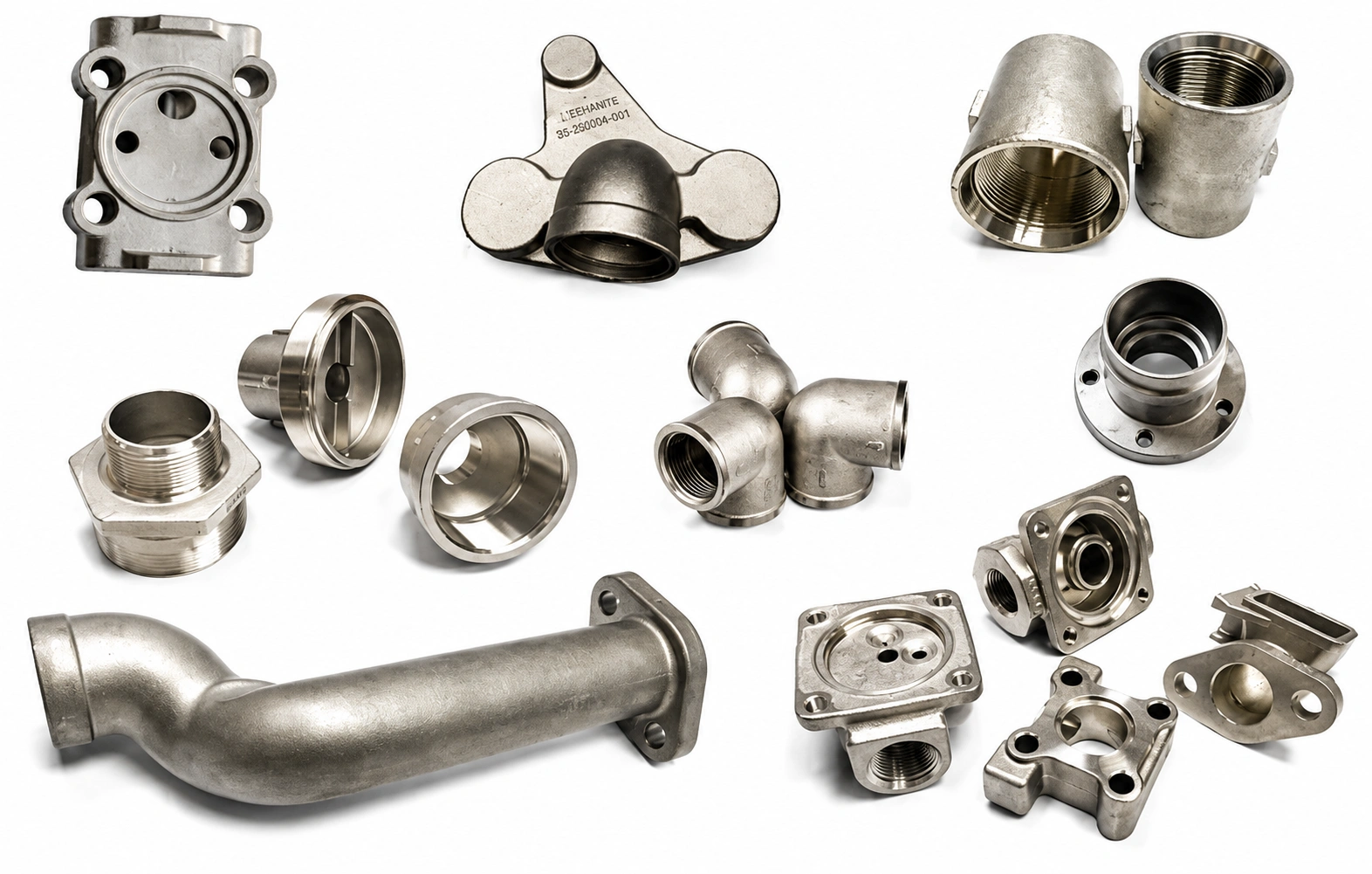
Custom investment-cast metal parts, including valve bodies, threaded fittings, flanges, housings, and industrial pipe components.

Process Selection Matrix: Investment Casting vs. Sand Casting

Choosing between metal casting methods depends on geometric complexity, dimensional tolerance requirements, and required surface finishes. The comparison table below highlights why engineers select lost-wax investment casting for precision applications.

Performance Specification ForceBeyond Investment Casting Standard Industrial Sand Casting
Surface Roughness (As-Cast) 63–125 RMS (Smooth / Near-Net) 250–500 RMS (Coarse)
Linear Tolerance Standard ±0.005 in/in (ISO 8062 CT5–CT7) ±0.030 in/in (Rough)
Minimum Wall Thickness Down to 0.040 in (1.0 mm) Minimum 0.180 in (4.5 mm)
Internal Geometry & Coring Complex, Draftless Internal Cavities Limited to Simple Draft-Angled Cores

Investment Casting Materials & Alloy Portfolio

The investment casting process offers unmatched material versatility, accommodating virtually any ferrous or non-ferrous alloy. ForceBeyond provides high-performance metallurgy through both standard air-melt and specialized Vacuum Induction Melting (VIM) investment casting processes.

Investment Casting Material Category Core Alloys Poured Key Features & Optimal Applications
Stainless Steel Investment Casting 304, 316L, 17-4 PH, 2205 Duplex Superior corrosion resistance and hygiene. Ideal for medical instruments, marine hardware, and high-pressure fluid valves.
Superalloy Investment Casting (VIM) Inconel 718, Inconel 625, Hastelloy X Extreme heat and fatigue resistance. Critical for aerospace engine components and industrial gas turbines.
Titanium Investment Casting Ti-6Al-4V (Grade 5) Unmatched strength-to-weight ratio. Used heavily in aerospace structural parts and biocompatible medical implants.
Carbon & Alloy Steel Investment Casting 1020, 1045, 4140, 8620 Excellent strength and toughness. Widely used for heavy machinery, automotive components, and industrial brackets.

Why Choose Investment Casting for Your Components?

When complex engineering designs call for thin walls, intricate internal passages, and tight geometric features, precision investment casting regularly outperforms sand casting, forging, and direct CNC machining from solid billet.

  • Unrestricted Design Freedom: Because lost-wax investment casting uses a sacrificial pattern encased in a ceramic shell, designs don't require mold draft angles or split-line compromises. You can easily cast complex internal coring that cannot be machined.
  • Near-Net-Shape Accuracy: Standard investment casting tolerances hold tight parameters (ISO 8062 CT5 to CT7), significantly reducing or completely eliminating secondary machining costs.
  • Superior Surface Finish: Ceramic slurry shell building produces smooth as-cast surface finishes (typically 63–125 RMS), perfect for fluid handling components or parts requiring immediate surface treatment.
  • Minimal Waste on High-Cost Alloys: Machining complex shapes out of solid blocks of Titanium or Inconel creates massive scrap loss. Lost-wax investment casting places material only where it is needed, driving down overall raw material expenses.

Step-by-Step: The Lost-Wax Investment Casting Process

ForceBeyond utilizes robotic shelling equipment and automated wax injection systems to maintain strict lot-to-lot consistency across all investment casting runs.

  • 1. Wax Injection & Pattern Assembly: Precision aluminum tooling injects sacrificial wax patterns, which are meticulously assembled onto a central wax sprue (or "tree").
  • 2. Ceramic Shell Investment: The assembled wax tree is systematically dipped into high-grade refractory slurries and ceramic sands to build a dense, thermally stable shell.
  • 3. Dewaxing & High-Temp Firing: Autoclave heating melts out the internal wax—completing the "lost-wax" step—and the remaining ceramic shell is fired at high temperature to lock in structural integrity.
  • 4. Vacuum or Air Pouring & Knockout: Molten alloy is poured into the heated ceramic mold (under vacuum for reactive superalloys and titanium). After cooling, the ceramic shell is knocked away, and finished investment castings are separated from the main runner.

Tier-1.5 Integration: Complete Investment Casting & Machining

While near-net investment casting eliminates most metal removal, high-precision features still require finish machining. ForceBeyond provides a seamless Tier-1.5 single-source workflow to manage all secondary processing under one quality standard:

  • Precision CNC Machining : Integrated 5-axis milling, drilling, and tapping for critical mating features and tight-tolerance bores via multi-axis CNC machining centers.
  • Densification & Heat Treatment: Solution annealing, aging, and Hot Isostatic Pressing (HIP) to crush microporosity and boost fatigue life in critical investment castings.
  • Full Non-Destructive Testing (NDT): 100% Radiographic Testing (X-Ray) and Fluorescent Penetrant Inspection (FPI) for total structural assurance.
  • Surface Finishing: Electropolishing, chemical passivation, and specialized bead blasting for custom aesthetic and anti-corrosion requirements.

Frequently Asked Questions: Investment Casting Services

How does investment casting compare to sand casting?

Sand casting uses a reusable wood or metal pattern packed into sand, making it suitable for massive, heavy parts but producing rougher surfaces (250–500 RMS) and loose tolerances. Investment casting utilizes ceramic slurry shells over sacrificial wax to achieve ultra-smooth finishes (63–125 RMS), linear tolerances of ±0.005 in/in, and thin walls down to 0.040 inches.

What is the typical minimum wall thickness for an investment casting?

Depending on the alloy and geometry, precision investment casting can reliably produce wall thicknesses as thin as 0.040 inches (1.0 mm) for small geometries, while standard design guidelines target 0.060 inches to 0.125 inches.

Does ForceBeyond offer rapid prototyping for investment cast parts?

Yes. We utilize 3D-printed wax or SLA patterns to build ceramic shells for rapid prototype pours. This enables engineering teams to validate physical cast alloys and fluid dynamics before committing to hard aluminum production tooling.

Request a Quote for Precision Investment Casting Services

Contact our engineering team to review your 3D STEP files, evaluate alloy specifications, and receive a complete turnkey manufacturing quote.

Sources

Our Internal Resources for Die Casting, Investment Casting, Forging and Sand Casting