ForceBeyond Logo
Forged Inconel 718 rings and high-performance industrial components

Duplex & Super Duplex Stainless Steel Machining: High-Strength Alloys

Duplex & Super Duplex Stainless Steel Machining: High-Strength Alloys

ForceBeyond is a premier provider of specialized CNC machining services for Duplex and Super Duplex stainless steel components. Engineered for extreme environments, Duplex alloys (such as 2205) and Super Duplex alloys (such as 2507 and Zeron 100) offer twice the mechanical strength of standard 316L stainless steel, combined with unmatched resistance to chloride pitting and stress corrosion cracking (SCC).

However, machining Duplex alloys presents extreme manufacturing challenges. Due to their high yield strength, low thermal conductivity, and rapid work-hardening behavior, machining Duplex requires heavy machine rigidity, specialized tool geometries, and precise feed rates. ForceBeyond provides expert 5-axis CNC milling, turning, and threading for Duplex components, ensuring ultra-tight tolerances, zero tool-chatter, and defect-free surface integrity.

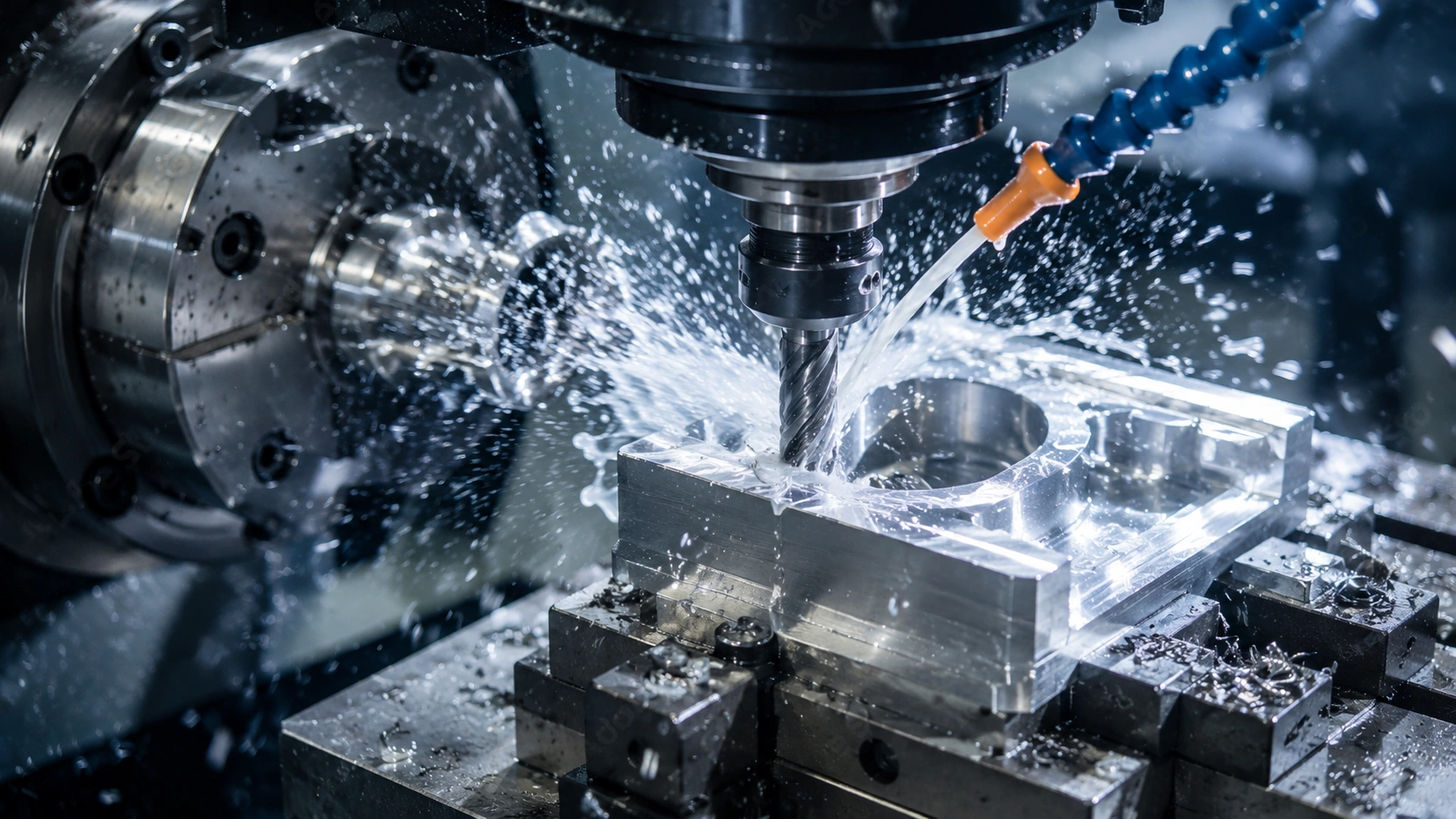
High-precision 5-axis CNC milling operation on a Super Duplex stainless steel component with coolant spray.

Technical Specifications: Machinability of Duplex Alloys

ForceBeyond routinely machines all cast and wrought grades of Duplex stainless steel. We tailor our cutting parameters, tool coatings, and coolant delivery to match the specific hardness and work-hardening characteristics of each alloy grade.

Alloy Grade Common Name Yield Strength Machinability & Machining Focus
UNS S31803 / S32205 Duplex 2205 (Grade 4A) 65,000 psi (450 MPa) High mechanical strength and work-hardening rate. Requires tough carbide inserts, sharp cutting edges, and low cutting speeds to prevent premature tool wear.
UNS S32750 Super Duplex 2507 (Grade 5A) 75,000 psi (515 MPa) High Chromium and Molybdenum content increases hardness and cutting resistance. Requires rigid setups, high-pressure coolant, and positive rake geometries.
UNS S32760 Zeron 100 (Grade 6A) 65,000 psi (450 MPa) Contains added copper and tungsten. Extremely tough media; demands high feed rates to ensure the cutting edge cuts below the work-hardened surface layer.
UNS J93370 CD4MCuN (Grade 1B) 70,000 psi (485 MPa) Widely used cast Duplex alloy with exceptional erosion-corrosion resistance. Machined extensively for heavy-duty pump impellers and marine housings.

Engineering Strategy: Overcoming Machining Challenges

Machining Duplex alloys on standard machinery often leads to rapid tool failure, poor surface finishes, and out-of-tolerance parts. ForceBeyond overcomes these challenges through specialized engineering controls:

  • Mitigating Work-Hardening: Duplex stainless steels work-harden almost instantaneously under the pressure of a cutting tool. Our programmers maintain continuous, positive feed rates to ensure the cutting tool edge always penetrates beneath the work-hardened layer created by the previous pass.
  • High-Pressure Coolant Delivery: Because Duplex alloys have poor thermal conductivity, heat accumulates rapidly at the cutting zone. We utilize high-pressure, through-spindle coolant systems to flush hot chips away instantly, protecting both the part geometry and the cutting tool edge.
  • Extreme Machine Rigidity: To prevent chatter and vibration—which accelerates work-hardening and ruins fine sealing faces—we utilize heavy-duty, high-rigidity 5-axis CNC machining centers and rigid workholding fixtures.
  • Specialized Insert Tooling: We use micro-grain carbide and cermet cutting inserts with specialized PVD coatings (such as TiAlN) specifically designed for super-austenitic and Duplex stainless steels.

Tier-1.5 Integration: Cast-to-Machine Duplex Solutions

Machining a complex component (like a multi-stage pump volute or high-pressure valve body) directly from a massive solid block of Super Duplex bar stock is extremely slow, tool-intensive, and wasteful. ForceBeyond operates on a Tier-1.5 Manufacturing Model, providing the ultimate cost-effective solution:

  • Near-Net-Shape Casting: We utilize our advanced investment foundry network to pour a dense, high-purity Duplex or Super Duplex investment casting that matches your part's complex profile.
  • In-House Heat Treatment: The raw casting undergoes solution annealing and rapid water-quenching to lock in the required 50/50 ferrite-austenite microstructure (and completely suppress harmful Sigma phase).
  • Precision CNC Machining: The near-net casting moves straight into our CNC machining centers, where we machine only the critical sealing faces, mounting flanges, and threaded ports to final, ultra-tight print tolerances.

This integrated process eliminates up to 70% of the machining time and raw material waste, delivering a fully certified part at a vastly reduced unit cost.


Certified Duplex & Super Duplex Machining Applications

ForceBeyond provides precision-machined Duplex and Super Duplex components to the world’s most demanding industries:

  • Oil & Gas (Upstream & Subsea): High-pressure subsea valve bodies, blowout preventer (BOP) components, drill collars, and sour gas (H2S) manifold fittings.
  • Desalination & Marine: Saltwater intake pump impellers, high-pressure reverse osmosis manifolds, and propeller shaft hardware.
  • Chemical Processing: Heavy-duty agitators, acidic fluid valve stems, heat exchanger tube sheets, and reactor fittings.
  • Pulp & Paper: Bleaching plant digester valves and heavy-duty slurry pump housings.

Frequently Asked Questions: Duplex Machining

Why is Duplex stainless steel so much harder to machine than 316L?

Duplex stainless steels have roughly double the yield strength of 316L, meaning it takes significantly more force to shear the metal into a chip. Additionally, Duplex alloys work-harden much faster, generating extreme friction and heat that can quickly destroy standard cutting tools if cutting speeds and feed rates are not perfectly optimized.

How does ForceBeyond verify the quality of machined Duplex parts?

Every machined Duplex component undergoes rigorous quality assurance. We provide 100% CMM inspection for tight tolerances, Positive Material Identification (PMI) to verify alloy composition, Liquid Penetrant Inspection (LPI) for surface integrity, and full Material Test Reports (MTRs) certifying compliance with ASTM standards and NACE MR0175/ISO 15156 for sour gas service.

Does secondary CNC machining affect the corrosion resistance of Duplex steel?

If done incorrectly, yes—excessive heat generation during machining can disrupt the alloy's microstructure or embed free iron on the surface. ForceBeyond uses precise thermal controls during machining, followed by chemical passivation treatments, to ensure the protective chromium-oxide layer is fully restored, preserving maximum corrosion resistance.

Request Quote For Duplex Stainless Steel Machining

Sources

Our Internal Resources for Die Casting, Investment casting, Forging and Sand Casting