ForceBeyond Logo
Forged Inconel 718 rings and high-performance industrial components

Multi-Axis CNC Milling & Turning: 5-Axis Precision Machining

Multi-Axis CNC Milling & Turning: 5-Axis Precision Machining

ForceBeyond is a premier manufacturer of highly complex, tight-tolerance components utilizing advanced multi-axis CNC milling and turning centers. When component geometries are too intricate for standard 3-axis machines, our state-of-the-art 5-axis mills and mill-turn (Swiss-style) lathes provide the ultimate solution for precision, speed, and dimensional accuracy.

By utilizing simultaneous 5-axis movement and live-tooling lathes, we can machine the most demanding features—such as deep undercuts, contoured surfaces, and intersecting off-axis holes—in a single, unified setup. From aerospace Titanium impellers to medical-grade stainless steel bone screws, ForceBeyond delivers flawless multi-axis components with zero-defect traceability.

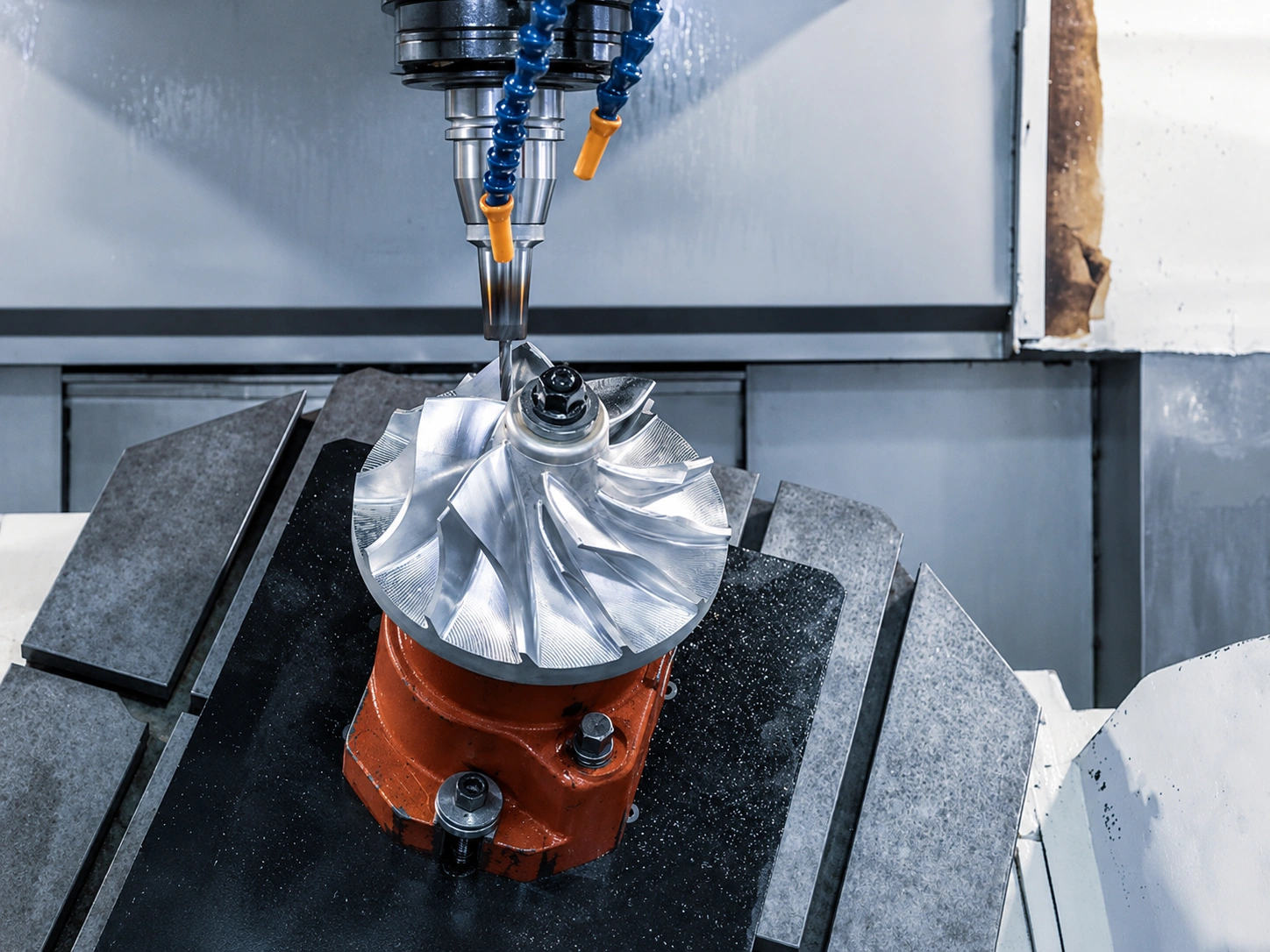
Five-axis CNC machining center cutting a high-precision jet engine turbine impeller with complex curved blades.

Technical Capabilities: Multi-Axis Technologies

ForceBeyond’s machining infrastructure is equipped with industry-leading multi-axis technology. We match the specific geometry of your engineering print to the most efficient machine configuration, ensuring both optimal tolerances and cost-efficiency.

Multi-Axis Technology How It Works Key Advantages & Applications
Simultaneous 5-Axis Milling The cutting tool and the workpiece move across the X, Y, and Z linear axes, while simultaneously rotating on the A and B axes. Allows for continuous cutting of complex, sweeping contours. Mandatory for aerospace turbine blades, impellers, and fluid-dynamic geometries.
3+2 Axis Milling (Positional) The part is rotated to a specific angle on the 4th and 5th axes, locked into place, and then machined using standard 3-axis motion. Ideal for parts with deep cavities or off-angle holes. Allows the use of shorter, more rigid cutting tools for tighter tolerances and better surface finishes.
Mill-Turn Machining (Live Tooling) A CNC lathe equipped with a milling spindle. It spins the part for turning operations and stops the spindle to perform off-axis milling, drilling, and tapping. The ultimate solution for complex cylindrical parts. Eliminates the need to move a part from a lathe to a mill, drastically reducing cycle times and handling errors.
Swiss-Style Turning A specialized mill-turn lathe where the bar stock is fed through a guide bushing directly past the cutting tools. Provides extreme rigidity for turning very long, ultra-thin components (like medical bone screws and firing pins) without part deflection.

Why Partner with ForceBeyond for Multi-Axis Machining?

Attempting to machine a highly complex part on traditional 3-axis equipment requires multiple manual re-fixturings. Our multi-axis approach provides distinct mechanical and economic advantages:

  • "Done-in-One" Single Setup Machining: Every time a machinist unclamps a part and moves it to a new fixture, dimensional alignment errors (tolerance stacking) occur. Multi-axis machines access 5 sides of a part in a single setup, guaranteeing absolute true position and concentricity across all features.
  • Superior Surface Finishes: Because 5-axis machines can continuously adjust the angle of the cutting tool relative to the part, the cutter maintains optimal engagement. This prevents tool rubbing and chatter, yielding a brilliant, mirror-like surface finish.
  • Shorter Cutting Tools: Multi-axis capability allows the spindle to tilt the cutting tool closer to the workpiece. Shorter tools are significantly more rigid, which reduces vibration, extends tool life, and holds much tighter micro-tolerances.
  • Faster Speed-to-Market: By eliminating the need for multiple machines, custom fixtures for every angle, and heavy manual handling, multi-axis machining dramatically reduces overall production cycle times.
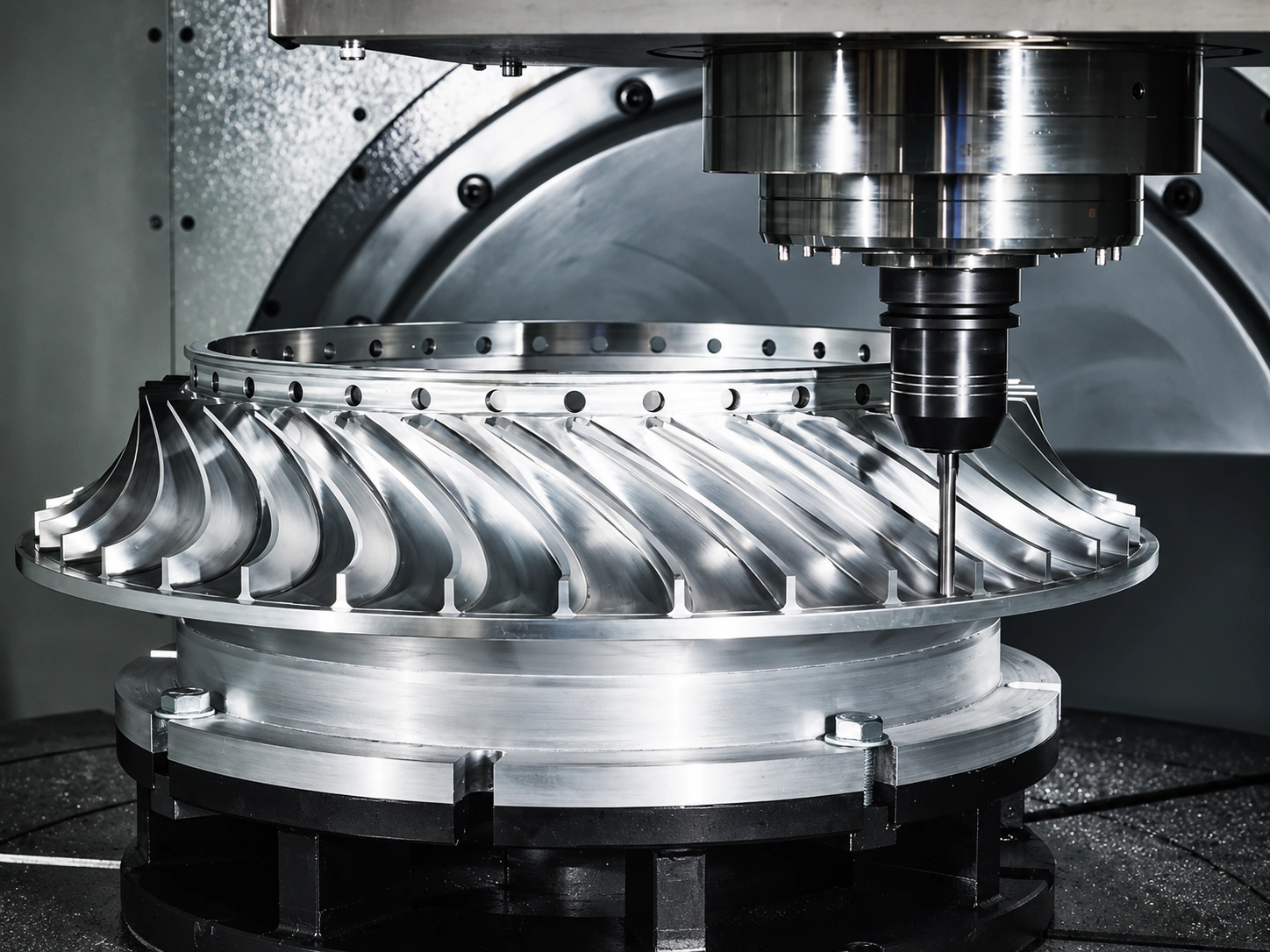
5-axis-CNC-milling-machine-work-metal-processing-impeller

Material Expertise: Machining High-Performance Alloys

Multi-axis machining is especially critical when dealing with hard-to-machine superalloys, as it maximizes tool life and rigidity. ForceBeyond specializes in the 5-axis machining of:

  • Aerospace Superalloys: Inconel 718, Inconel 625, and Hastelloy (requiring extreme machine rigidity and high-pressure coolant).
  • Titanium: Ti-6Al-4V (Grade 5) for lightweight, high-strength aerospace brackets and medical implants.
  • High-Strength Stainless: 17-4 PH, 316L, and Duplex/Super Duplex alloys for harsh marine and chemical environments.

Certified Multi-Axis Applications

Our advanced 5-axis and mill-turn centers produce mission-critical components for:

  • Aerospace & Defense: Jet engine impellers, blisks (bladed disks), fuel manifold housings, and landing gear linkages.
  • Medical Devices: Orthopedic implants, complex surgical instruments, and multi-faceted diagnostic equipment housings.
  • Oil, Gas & Energy: Subsea flow-control valve bodies, downhole drilling components, and complex pump volutes.
  • Automotive & Motorsport: Custom multi-port cylinder heads, lightweight suspension knuckles, and complex transmission valving.

Frequently Asked Questions: Multi-Axis Machining

What is the difference between 3+2 Axis and Simultaneous 5-Axis machining?

In 3+2 axis (also called positional 5-axis), the machine uses the 4th and 5th axes to rotate the part to a fixed angle, locks it down, and then cuts using the standard 3 axes. In simultaneous 5-axis, all five axes are moving and cutting at the exact same time. Simultaneous 5-axis is required for smooth, continuous curves (like a propeller blade), while 3+2 is faster and highly effective for parts with flat features at odd angles.

Are multi-axis machined parts more expensive?

The hourly rate for a 5-axis machine is higher than a 3-axis machine. However, for complex parts, multi-axis machining is actually cheaper overall. It eliminates the need to design and build multiple expensive custom fixtures, and it removes the heavy labor costs of an operator manually moving the part between multiple different machines.

Can you perform multi-axis machining on near-net-shape castings or forgings?

Yes. This is a core strength of ForceBeyond’s Tier-1.5 model. We routinely take highly complex investment castings or closed-die forgings and place them into our 5-axis centers to machine the critical datum points, sealing faces, and threaded holes to their final, ultra-tight tolerances.

Request Quote For Multi-Axis CNC Milling & Turning

Sources

Our Internal Resources for Die Casting, Investment casting, Forging and Sand Casting